The Most Innovative Cannabis Software of 2026
Market Analysis · By Headquarters · August 26, 2026
Cannabis software gets reviewed the way ordinary software gets reviewed: feature grids, integration counts, badges on comparison pages the vendors wrote themselves. None of that explains why these particular companies matter.
The ten platforms below are not winning on features. They are winning because cannabis operators cannot get normal banking, normal card processing, normal working capital, or normal tax treatment, and somebody had to build the missing pieces. So the software vendors did. A wholesale marketplace started extending trade credit. An ERP now originates loans. A payroll company spends most of its energy managing a tax position.
Whitney Economics put a number on the problem underneath all of it, and LeafLink cited that number in its own announcement: late payments in cannabis totaled more than $3.8 billion in 2023, roughly 1.6 months of every legal dollar the industry sold. That is an industry running on handshake terms because the credit infrastructure everyone else uses is closed to it. Most of this list is a response to that one problem.
LeafLink - Getting Paid When the Product Actually Sells
LeafLink turned ten in February 2026, counting from its first sale on February 23, 2016, and now spans 34 U.S. markets with tens of billions in cumulative sales. Current CEO Ashwin Raj describes the company as "a critical infrastructure layer for the legal cannabis industry," which is unusually accurate for a corporate anniversary quote.
The product worth studying is Payment on Sell-Through. Brands receive automated weekly payments based on the prior week's retail sell-through data, and retailers pay as product moves off the shelf rather than fronting cash for bulk inventory. It launched in September 2024 across Michigan, Mississippi, and Colorado.
Call that a payments feature if you like, but it functions more like a credit instrument, built for a wholesale channel where financing options are still thin relative to demand and a brand that gets stiffed has little practical recourse. Then-CEO Artie Minson framed it as ending delinquent payments while reducing retailer upfront spend. That is the polite description of a system where both sides had learned to expect nonpayment.
The company also bought Dama Financial's banking division in July 2024 and the competing marketplace Leaf Trade that November. Ten years in, the marketplace is the smallest part of what LeafLink sells.
Aeropay - The Only Legal Rail, Built Properly

Visa and Mastercard will not process cannabis. For years the industry's answer was cashless ATM workarounds that regulators kept shutting down. Aeropay took the opposite approach and built a real bank-to-bank network on ACH, with no card rails involved at any point.
The bet worked. By its $20 million Series B in May 2024, led by Group 11, the company was processing over $1 billion annually, had grown revenue tenfold year over year, and had reached cash-flow profitability the previous quarter. It now sits underneath Flowhub, Jane, Dispense, and others as plumbing rather than a product operators think about.
What separates Aeropay from the workarounds is that it treated the constraint as permanent and engineered for it. Everyone else treated it as a temporary inconvenience to be routed around until federal reform arrived. Federal reform did not arrive.
Jane - Sending Money Back Down the Same Pipe

Cannabis brands cannot ship direct to consumer, which denies them the loop every other consumer packaged goods company depends on: reach a shopper, fund an incentive, measure what came back.
Jane built the loop anyway. Jane Gold, which the company says runs on patented technology, lets brands fund cash back that reaches the shopper directly over ACH bank-to-bank transfer, without cutting into retailer margin. In February 2026 Jane announced the program had passed $1 million in cash back distributed.
The results Jane reports are more interesting than the milestone itself. The company says Jane Gold shoppers spend 57% more per transaction when redeeming an offer, that the program has generated $1.1 million in incremental sales for brands and $3.5 million for nearly 1,000 participating retailers, and that one in ten online shoppers enrolled during a ten-market beta. Those figures are self-reported.
CEO Socrates Rosenfeld's claim at launch was that this "unlocks a new paradigm for omnichannel ecommerce, something the likes of Uber, Shopify, and Amazon have yet to implement in the retail verticals they serve." Read alongside Aeropay, it is the same insight pointed in the opposite direction: Aeropay uses ACH to bring money in, Jane uses it to push money back out, and neither company picked that rail so much as ran out of alternatives.
Distru - The ERP That Started Lending
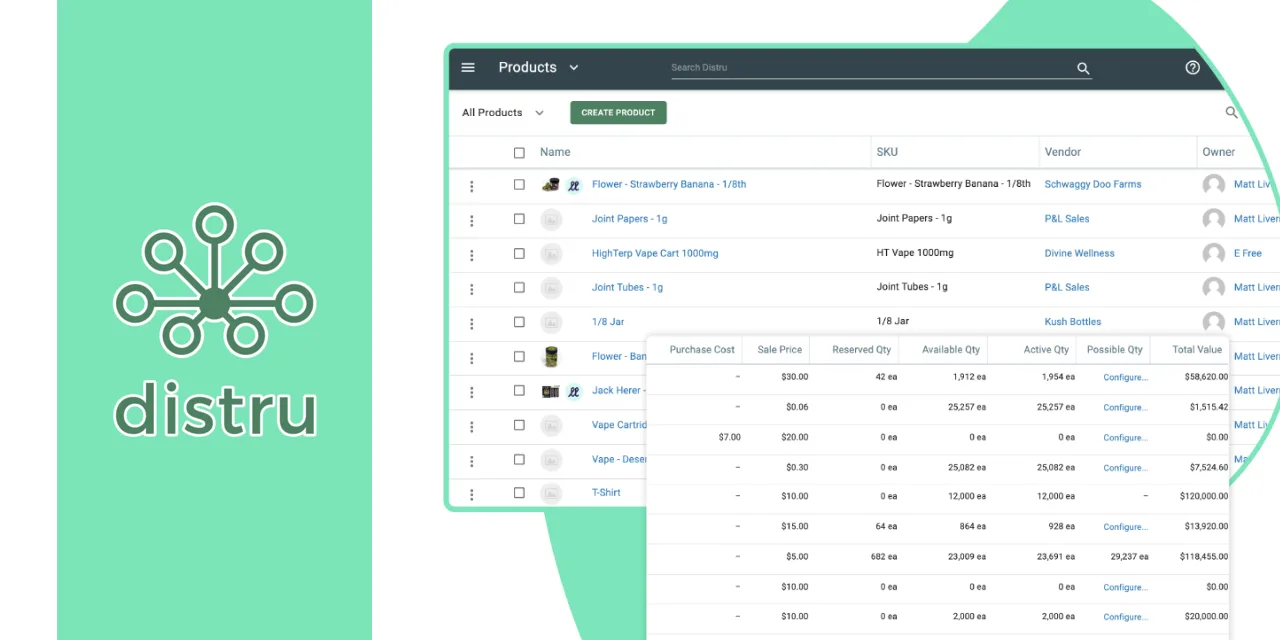
Distru raised a $6 million Series A led by Poseidon Investment Management in November 2024, at which point it was operating across 25 states, processing more than $2 billion in annual gross merchandise value, and running profitably. Its earlier investors include Felicis Ventures and Elad Gil, which says more about where serious technology money sees this category than any cannabis-specific fund would.
Then there is the FundCanna integration, which puts working capital inside the ERP itself, so an operator sees a purchase order and a financing option for it on the same screen. Distru already knows that operator's inventory, order history, and payment behavior better than an outside lender could underwrite. Once you hold that data, becoming the credit channel is less a pivot than the next obvious product.
Würk - Payroll as a Tax Position
IRC Section 280E denies cannabis businesses ordinary deductions, and Würk says so on its own site in unusually blunt terms, calling it "an antiquated code stating that 'no deduction or credit shall be allowed in running a business that consists of trafficking a controlled substance.'"
The consequence is that how a cannabis company classifies labor determines what it can deduct. Wages tied to cultivation, processing, and packaging can flow into cost of goods sold. Wages that cannot be documented that way are simply lost. Payroll stops being an administrative function and becomes one of the largest levers on the tax bill, which is not true in any other industry.
Würk built the platform around that, and it has real reach. As of a September 2024 announcement: all 50 states plus Puerto Rico, more than 5,100 jurisdictions, implementations averaging under 30 days, and clients including Curaleaf, Cresco Labs, and TerrAscend.
The positioning has moved since then. In 2024, CEO Deborah Saneman described Würk as offering cannabis "a safe haven" while other providers explored new industries. Today the homepage reads "Payroll & HR Solutions for Compliance-Centric Industries" and puts cannabis at the head of a list that runs through alcohol, gaming, healthcare, and construction. Cannabis is still first and still clearly the core business. But the umbrella got wider, and Würk is not the only company on this list where that happened.
Green Check - Compliance Good Enough to Export
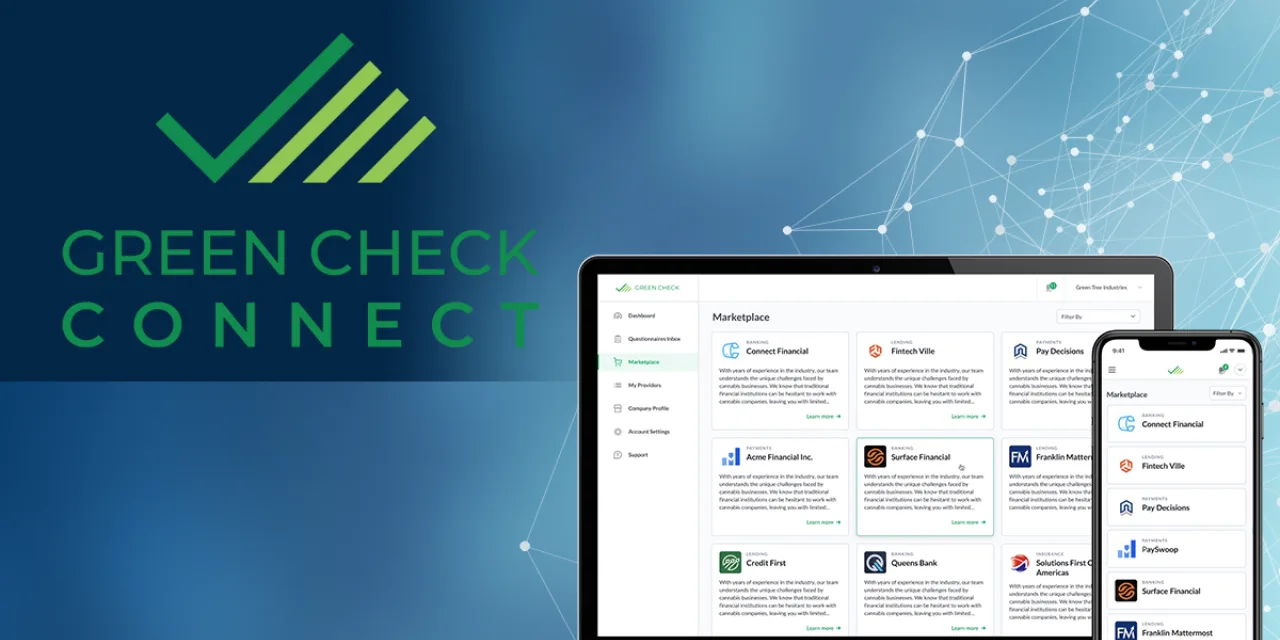
Green Check spent years solving one problem: giving banks enough monitoring and documentation to serve cannabis without failing an exam. It now connects financial institutions with more than 18,000 specialty businesses across 38 states.
In August 2026 it announced it was taking that platform into money services businesses, fintechs, gaming, ATM operators, NGOs and charities, and other cash-intensive verticals. Co-founder and Chief Strategy Officer Mike Kennedy put it plainly: "We built Green Check by starting with one of the most demanding verticals: cannabis. That experience gave us a strong foundation to expand into other high-risk industries."
Cannabis compliance turned out to be hard enough that solving it produced software sellable to industries with considerably more money in them. Green Check has also moved toward lending through a relationship with Coda Capital Advisors, which follows the same arc as LeafLink and Distru: start at compliance, end up at credit.
Canix - Buy the Competitor, Then Open the Data

Canix acquired competitor Trym on January 27, 2026, a deal Forbes covered as a marker of cannabis technology consolidation. Trym brought mobile-first crop steering, yield forecasting, sensor-driven environmental data, and task execution. Terms were not disclosed. Trym customers keep their platform for at least a year, which is a more graceful integration promise than this category usually offers. CEO Stacey Hronowski framed it as building "the most comprehensive, user-friendly operating system for cannabis operators."
The more forward-looking move came six months later. On July 9, 2026, Canix launched an MCP Server, letting operators connect their Canix data directly to AI assistants including Claude and ChatGPT and ask questions in plain language: revenue comparisons, facility-level breakdowns, account health and reorder rates, SKU and sales rep performance. Inventory querying is next, and a Sales Order Agent is in alpha. Canix describes it as the point where "the data you've spent years capturing in Canix can answer your questions directly, in plain language."
Most cannabis AI features are a vendor putting a conversational layer on its own dashboard, which the vendor still controls. An MCP server does close to the opposite. It hands the operator's data to whatever agent the operator chooses, and it accepts that the interface layer may end up belonging to somebody else entirely. Very few enterprise vendors in any industry have been willing to concede that yet. We have written before about what building agent skills on cannabis platforms actually involves, and the hard part is rarely the model.
Headset - Selling the Supply, Not the Dashboard
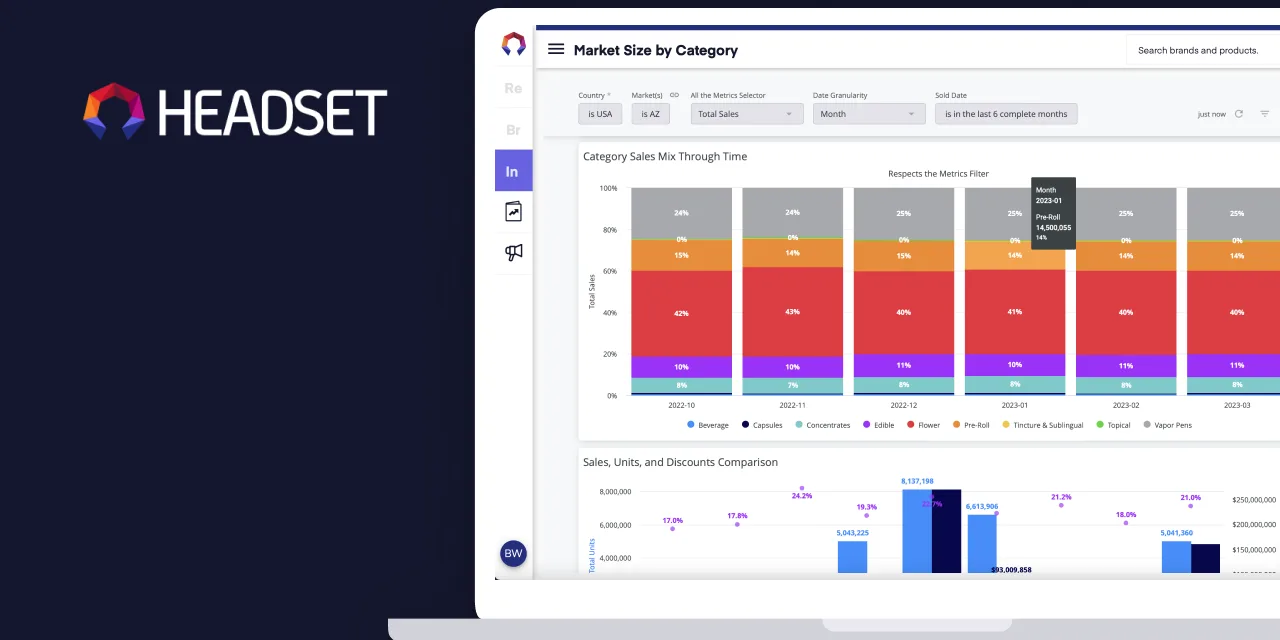
Headset reports direct point-of-sale integrations with more than 3,500 cannabis retailers across the U.S. and Canada, and claims that 34 cents of every dollar spent on cannabis in both countries flows through its data. Those numbers are the company's own and are not independently audited.
The decision worth copying is Vault, which delivers cannabis sales data into a customer's own analytics environment through Snowflake rather than keeping it inside a Headset dashboard. Most data companies fight to own the screen. Headset appears to have decided the screen was the replaceable part and the underlying data supply was not.
Its daily tracking of hemp-derived THC beverages across 15 states and more than 45 metro areas is currently the only serious measurement of the fastest-moving channel shift in the category. If you want to know whether the beverage story is real, that is where to look. For a wider view of the tooling in this space, see our guide to cannabis market analytics platforms.
Dutchie - Agentic Commerce Arrives Early, Out of Necessity

On June 15, 2026, Dutchie launched Consumer AI across a platform it says powers more than 6,500 dispensaries and has processed over $100 billion in transactions. There are four products: Voice AI, an AI phone receptionist that takes orders and answers questions about hours, directions, and live inventory; Agentic Commerce, a shopping agent that builds carts from natural language and rebuilds regular orders from purchase history; Register Co-Pilot, which hands budtenders purchase history and pairing suggestions at the counter; and Consumer Pulse, which runs sentiment analysis across surveys and public reviews.
The timing is the part to sit with. Cannabis retail shipped agentic commerce and voice ordering ahead of most of mainstream American retail, and not because the category is technically ahead. Google and Meta are effectively closed to it, so every customer interaction a dispensary owns has to work far harder than it would elsewhere.
CTO Chris Ostrowski described the approach as embedding AI "into systems businesses already rely on" rather than layering on disconnected tools. That is the right instinct, and also the one most likely to get ignored across the rest of the category.
Meadow - The Dispensary Stops Being a Place
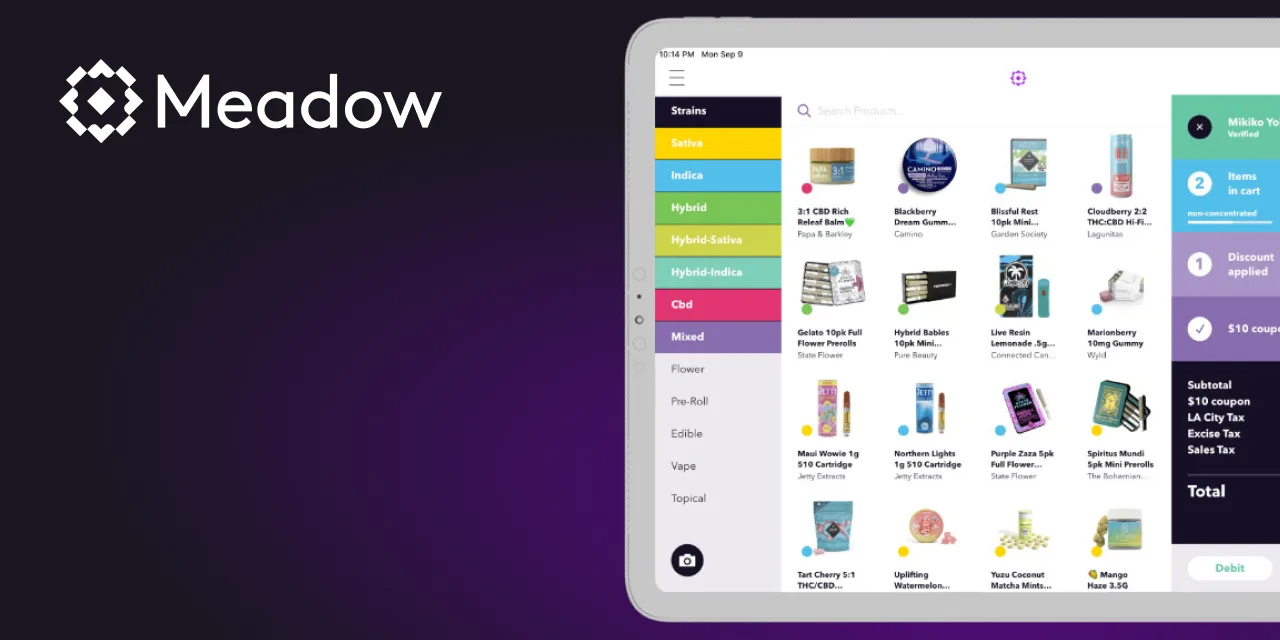
Meadow has built California cannabis retail and delivery software since 2014, and supports three delivery models: hub-and-spoke, hybrid, and the one worth paying attention to, which the company calls ice cream truck delivery.
Under that model a vehicle operates as an independent inventory location roaming a defined geographic zone, taking orders in real time and fulfilling them without returning to a hub between stops. Meadow describes the model as exclusive to its platform. The compliance machinery underneath handles daily Metrc uploads, real-time inventory sync, discrepancy alerts, and manifest generation, with two-way Onfleet dispatch on top.
The branding is silly and the idea is not. Every other operator on this list is optimizing a store, a menu, or a supply chain. Meadow's model dissolves the store and treats inventory as something that moves toward demand instead of waiting for it. California's delivery rules are what make that legal, which makes it the clearest case on this list of a constraint producing an invention rather than preventing one.
One caveat: Meadow publishes no performance data for the model and no launch date, so treat it as an idea worth understanding rather than a proven playbook.
Metrc - The Cautionary Half of the Story
Every other platform here earned its position because operators chose it. Metrc holds its position because state legislatures wrote it into law.
It is the most widely used software in American cannabis and the only entry on this list that no customer selected. Metrc has continued to win and extend government contracts, including in Illinois, Virginia, Massachusetts, Kentucky, and the U.S. Virgin Islands, and it has shipped real things: Metrc says its Retail ID product reached a one million weekly QR code run rate across 21 markets, and it launched direct-to-consumer product recall in California. The company has also hired a 25-year technology veteran to lead what it describes as a technology and product transformation.
That last announcement is the one to think about. A company with legally guaranteed demand telling the market it needs a product transformation says something about what happens to software when nobody can walk away from it.
Study Metrc for what mandated infrastructure does to a product roadmap. Do not study it for innovation. That is the point of including it.
The Pattern
Three themes tie these platforms together:
- Software became the balance sheet. Banks mostly will not lend to this industry, so the vendors did it themselves. LeafLink extends trade credit through Payment on Sell-Through. Distru puts working capital inside the ERP. Green Check moved from compliance monitoring into lending. Würk manages a tax position rather than just running payroll. Your software vendor is increasingly also your bank, and that concentration of dependency deserves more thought than it usually gets before anyone signs.
- Compliance stopped being a business. Track-and-trace integration used to be the entire pitch. It is now table stakes, and the money has moved to payments and data. Canix had to buy a competitor to stay ahead of it. Metrc is the extreme version of the same truth: compliance software with no competitive pressure has no reason to get better, and doesn't.
- The category is buying itself. Canix took Trym in January 2026. LeafLink absorbed Leaf Trade and Dama Financial. Metrc and BioTrack partnered in 2025. Consolidation, not AI, is the real 2026 story in cannabis software, and it means the number of vendors an operator can choose between keeps shrinking while the amount each one handles keeps growing.
For operators, the useful question is not which of these to buy. It is that choosing tooling now means making a financing decision, a tax decision, and a data-ownership decision at the same time, and most back offices are still running it as a software purchase.
That is usually where we come in.