The Most Innovative Dispensaries in the United States (2026)
Market Analysis · By Headquarters · August 10, 2026
Cannabis retail innovation gets judged on the wrong axis. The industry press rewards store design, which is the most visible thing a dispensary does and the least connected to revenue.
The ten operators below are doing something harder. Unable to buy Google, Meta, or broadcast the way ordinary retailers can, each one built a distribution channel it owns outright: a first-party app with 820,000 members, a sales holiday invented from scratch, a state fair concession, a permanently leased billboard in Times Square. The store design follows from that. It isn't the strategy.
Embarc - Bodega-Style Retail at Chain Scale
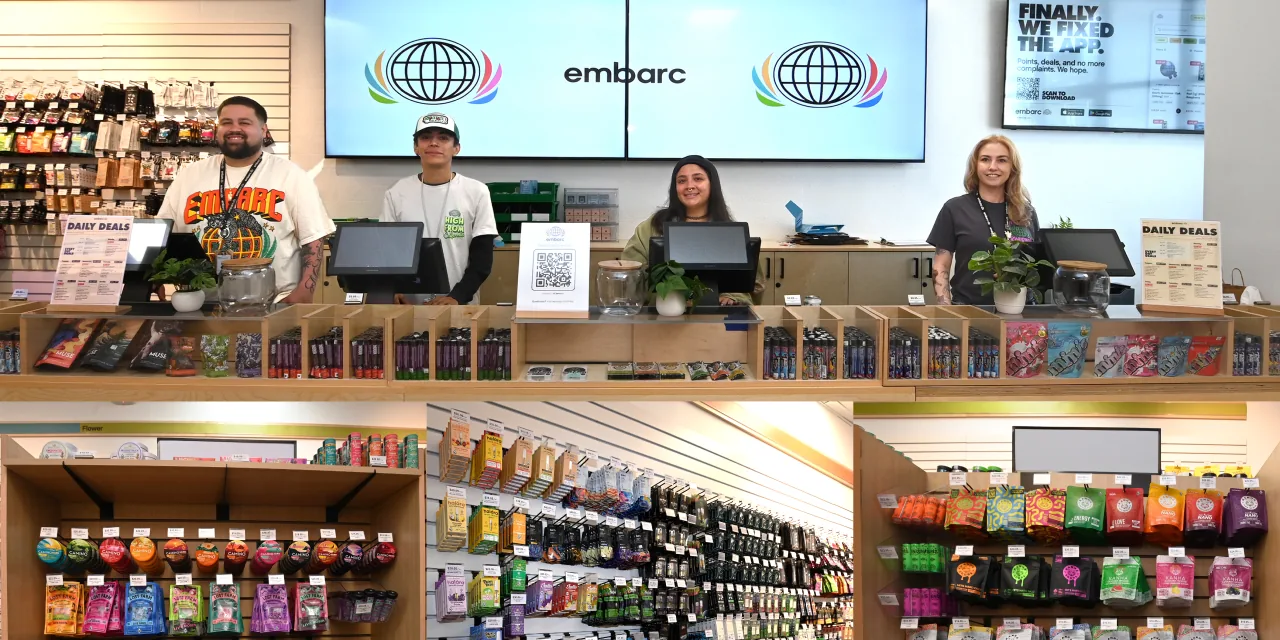
Plenty of operators have piloted self-select shelving. Embarc built it into the operating model of all 17 California stores. Customers take a basket, browse at their own pace, and smell product at a flower bar. Staff are titled Guides, not budtenders. Fairfield markets an "innovative bodega-style setup"; Alameda promotes an "in-store bodega style shopping experience" that "allows you to shop at your own pace in a familiar, approachable way." The point is to replace the vault-and-counter layout that signals contraband with one that signals a normal store.
The siting strategy is the underrated half. Co-founder and CEO Lauren Carpenter spent a decade in government and public affairs before launching the first store in South Lake Tahoe in June 2020, and Embarc deliberately targets jurisdictions that had previously refused retail licensing - Tahoe, Tracy, Fresno, Madera, Woodland - rather than fighting for saturated urban corners. The company pledges 1% of every store's revenue back into that store's own community and reports over $1.5 million given.
Then there's the events business, which nobody else has matched. Embarc presented the world's first onsite cannabis sales and consumption at a state fair at the 2024 California State Fair, including a 30,000-square-foot 21+ consumption area, and launched "The Smoke Show" at the California Roots Music & Arts Festival. Carpenter co-produces the California Cannabis Awards.
Trulieve - Loyalty as the Entire Acquisition Channel
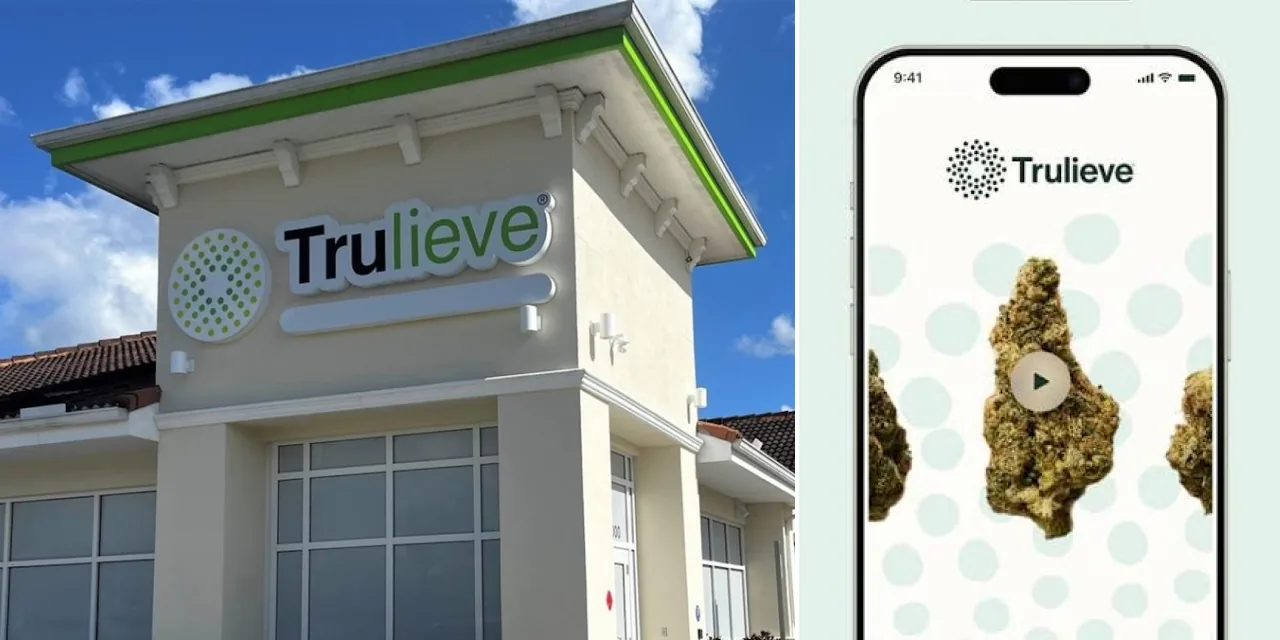
The headline number is the most quotable benchmark in U.S. cannabis retail: loyalty members drove 77% of transactions in Q3 2025, against 820,000 enrolled members, up from 68% and 625,000 two quarters earlier. Members spend 2.5x more than non-members.
The mechanics are what to copy. Enrollment is a QR scan at every point of sale plus 20 bonus points, not a budtender script. Points expire in 90 days, which converts a passive balance into a recurring visit deadline and is the single most underrated design decision in the program. The tier ladder is gated on annual spend - Tru-Member, Tru-Insider at $1,250, Tru-Elite at $2,750, Tru-Icon at $4,750 - and every tier earns the same 1 point per dollar. What scales is redemption power, from 250 points for $10 at the base up to 2,000 points for $160 at the top. That's the cheaper lever, and it's airline status mechanics applied to a category that mostly still runs punch cards.
All of it feeds a first-party mobile app carrying tier status and member-only offers. In an industry where paid digital is heavily restricted, an app with 820,000 enrolled users isn't a convenience feature. It's the media network.
The Daily Green - Real Estate as the Ad Buy
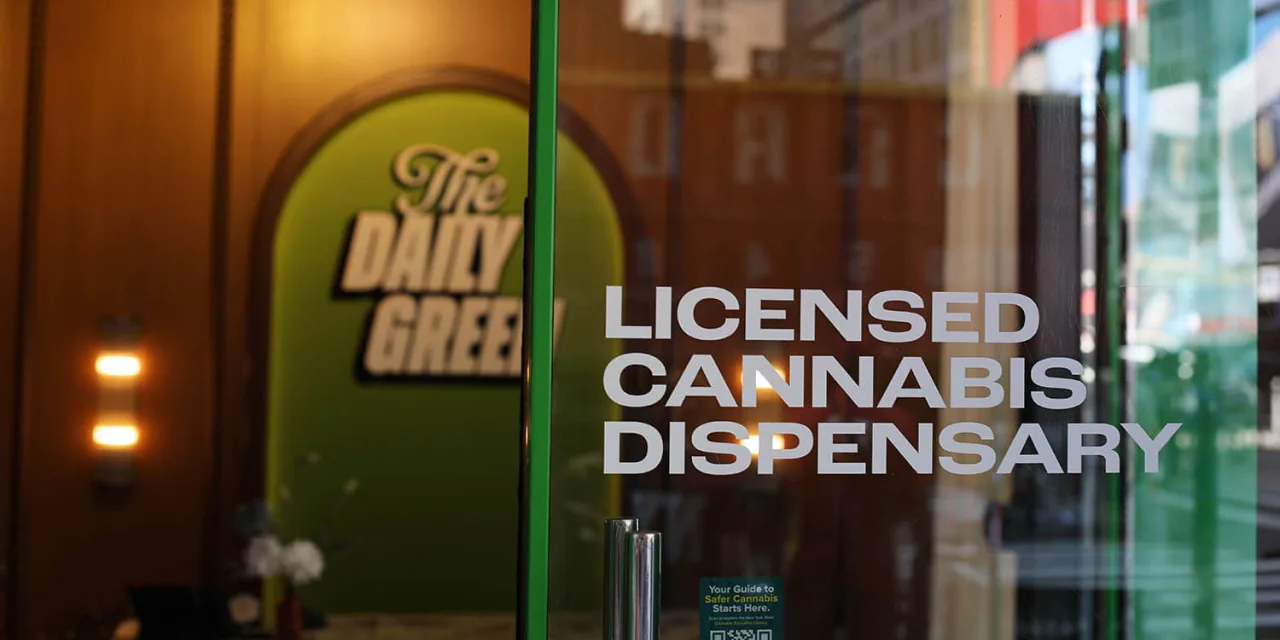
The most literal answer anyone has given to the advertising problem: lease the billboard building and put the store inside it.
In July 2024, William Norgard signed a 20-year lease on the entire 10,040-square-foot, four-story building at 30 Times Square, a property Commercial Observer described as "bedecked with billboards." The store opened August 8, 2025 with a green façade, a massive digital sign, and scrolling news-ticker displays.
Run the arithmetic. Times Square carries roughly 200,000 to 250,000 pedestrians a day, peaking near 400,000, with about a million people working nearby. A prime digital board there rents for $10,000 to $50,000 per day, and a single day on the Nasdaq Tower starts around $17,500. The Daily Green converted a recurring media cost into a fixed 20-year real estate cost.
The concept runs all the way down, which is rarer. The brand is built on New York media history, and the loyalty program is called the Press Pass Club with three tiers named Columnist, Editor, and Publisher. Most operators pick a storefront theme and then name their loyalty tiers Bronze, Silver, Gold. Brand strategist Maggie Connors on the in-store bud bar: "seeing the products being able to hold them be able to smell the cannabis itself just brings it to life."
Perfect Union - The Manufactured Holiday, With Receipts
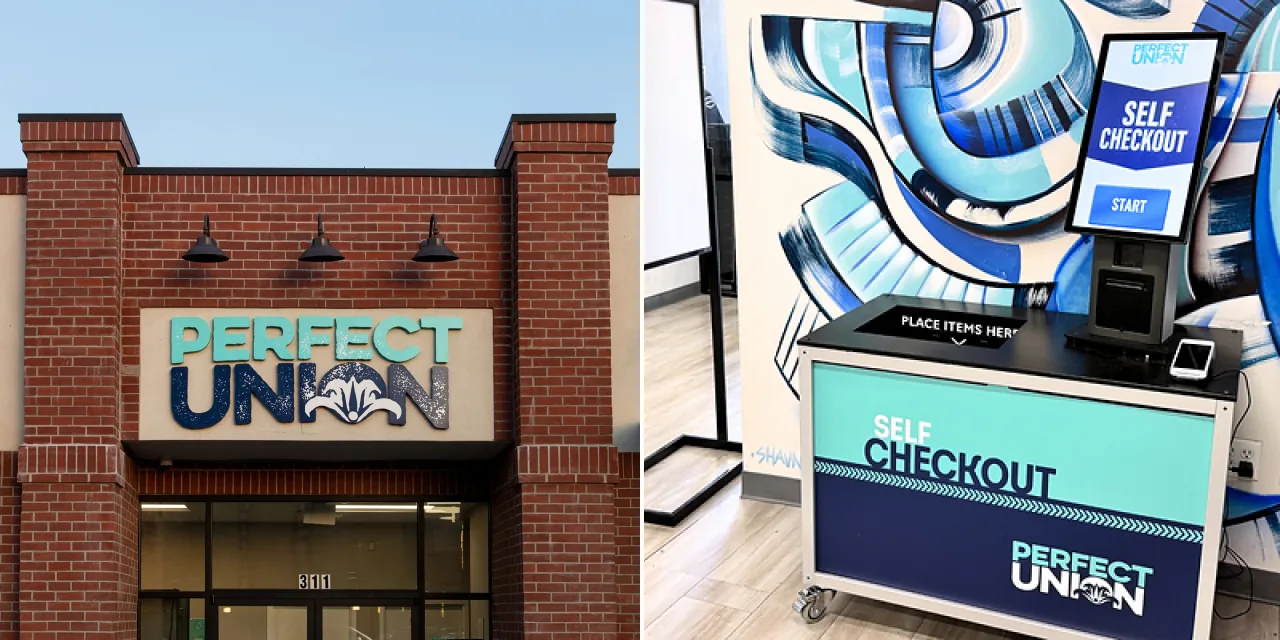
Most dispensaries have one sales holiday. Perfect Union's parent, MWG Holdings Group, built a second one from scratch - "Oil Day," every July 10 - and then did the thing almost nobody in cannabis does, which is publish the year-over-year numbers.
Oil Day 2026 versus 2025: net revenue up 61%, guest transactions up 53%, units sold up 78%. The prior year's lifts were 54%, 47%, and 71%. The gains are widening, which means the date is being learned by the customer base rather than discounted into existence. That distinction is the whole ballgame for anyone evaluating whether a promotional calendar is building equity or renting volume.
Supporting credentials: BDSA ranks the Northside Sacramento flagship as the highest daily-revenue-generating dispensary storefront in California year to date in 2026, and the portfolio has posted four straight years of double-digit growth. VP of Marketing Nicole Hanratty credits the experiential layer - food trucks, live music - for beating projections. The replicable version is four steps: pick a date you can own, program it as an event, instrument it, publish the lift.
Mint Cannabis - Throughput Instead of Dwell Time
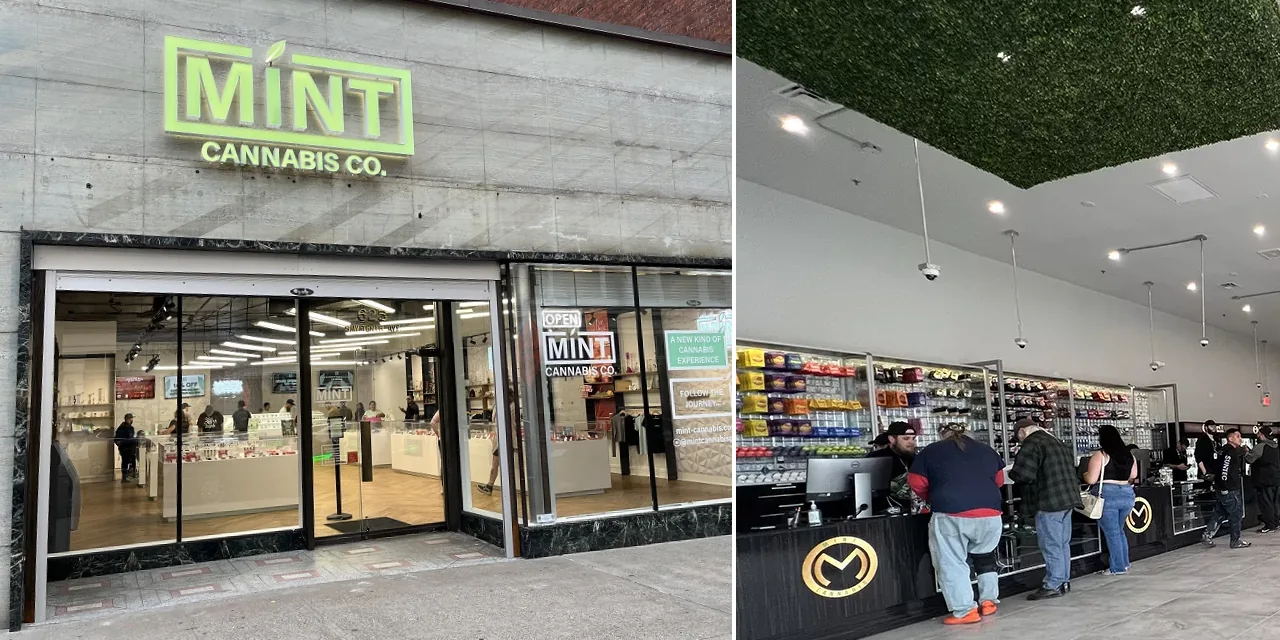
Mint's record is a list of dated operational firsts rather than a marketing posture: the nation's first cannabis kitchen in 2018, an on-site grow in 2019, a drive-thru in 2020, online ordering in 2021, shuttle service in 2022. The Commercial Cannabis Awards named it Most Innovative Medical Cannabis Dispensary. Several Arizona stores run 24 hours.
The 2026 developments make the thesis unmistakable. Mint entered Florida with 18 medical dispensaries in December 2025. In August 2026 it began converting a former Wendy's near Midtown Tampa into a drive-through pickup location. In June it partnered with the Moapa Band of Paiutes to open inside a travel plaza at I-15 Exit 75, in a former casino space, with a grand opening tied to the tribe's Rock the Sky festival.
Taking over decommissioned quick-service real estate states the position plainly: borrow fast food's throughput model, not luxury retail's. Mint is the precise inverse of Embarc, and the contrast is the most useful strategic question on this list. Optimize for discovery or optimize for speed. The failure mode is a store that half-commits to both.
The Travel Agency - Design as Earned Media
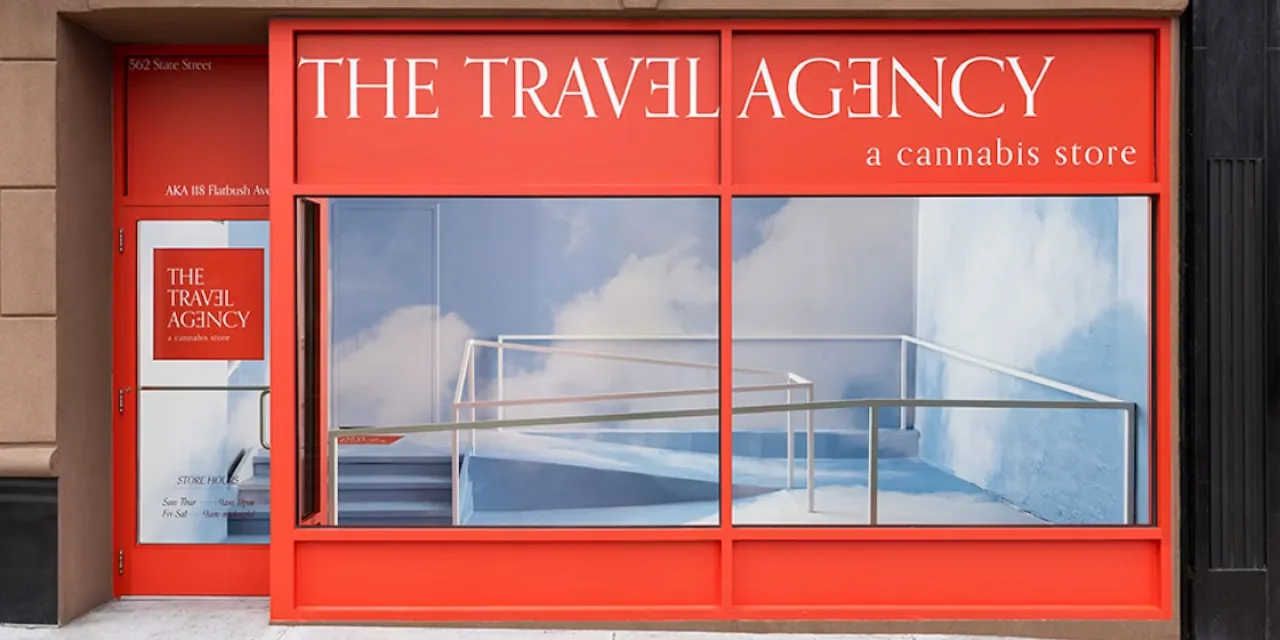
Four New York stores - Union Square, Downtown Brooklyn, Fifth Avenue, and a SoHo flagship at 598 Broadway that opened May 2025 - designed with Leong Leong Architecture to read as galleries rather than head shops. Co-designer Chris Leong described the intent directly: "you won't find any black plastic bag inventory, Bob Marley rolling trays, or pot leaf-patterned wallpaper. Instead you'll experience a soft minimal space more akin to a luxury jewelry or fragrance store."
SoHo carries a kinetic, data-driven installation by Andrew Zolty of Breakfast Studio and a curated bong gallery with pieces by Serena Confalonieri and Juan Manuel Carmona. The Union Square location directs more than half its proceeds to The Doe Fund, which supports people affected by incarceration and homelessness.
The BIPOC-founded chain, led by co-founder and president Arana Hankin-Biggers, generates national design press that no advertising budget can buy. That's the mechanism worth naming: in a restricted category, an editorially interesting store is a media budget.
The Artist Tree - Retail as Cultural Venue
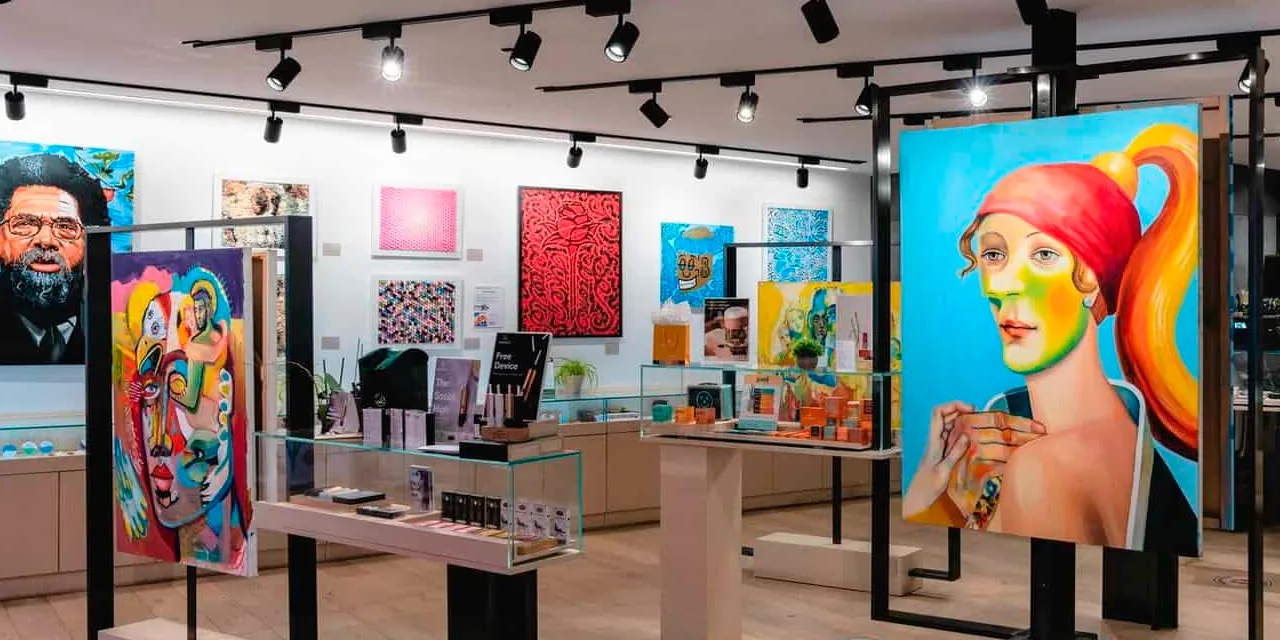
Roughly a dozen California locations built around a rotating in-store art gallery, with new exhibits every few months, a QR code under each piece, and 100% of art sales going directly to the artist. The founders' framing: "We don't take a cut, because we believe artists should actually get paid for their work."
Two consumption lounges anchor the programming. The West Hollywood Studio lounge opened on 4/20/2022 with tableside service, non-alcoholic canna-cocktails, DJ sets, and a tabletop rosin press. The Hawthorne lounge near LAX opened in August 2024 as the first legal consumption lounge in Los Angeles County outside West Hollywood. Programming runs to open mics, "Puff, Puff, Paint" classes, sound baths, comedy, and high tea. The WeHo flagship, designed by Retail Design Collaborative, was the only applicant to qualify for all five of West Hollywood's cannabis license categories.
Loyalty runs through the Canvas Club on AlpineIQ. The events calendar is what makes the loyalty program worth joining, which is the correct sequencing and the opposite of how most operators build one.
Green Qween - Identity-Led Brand Building
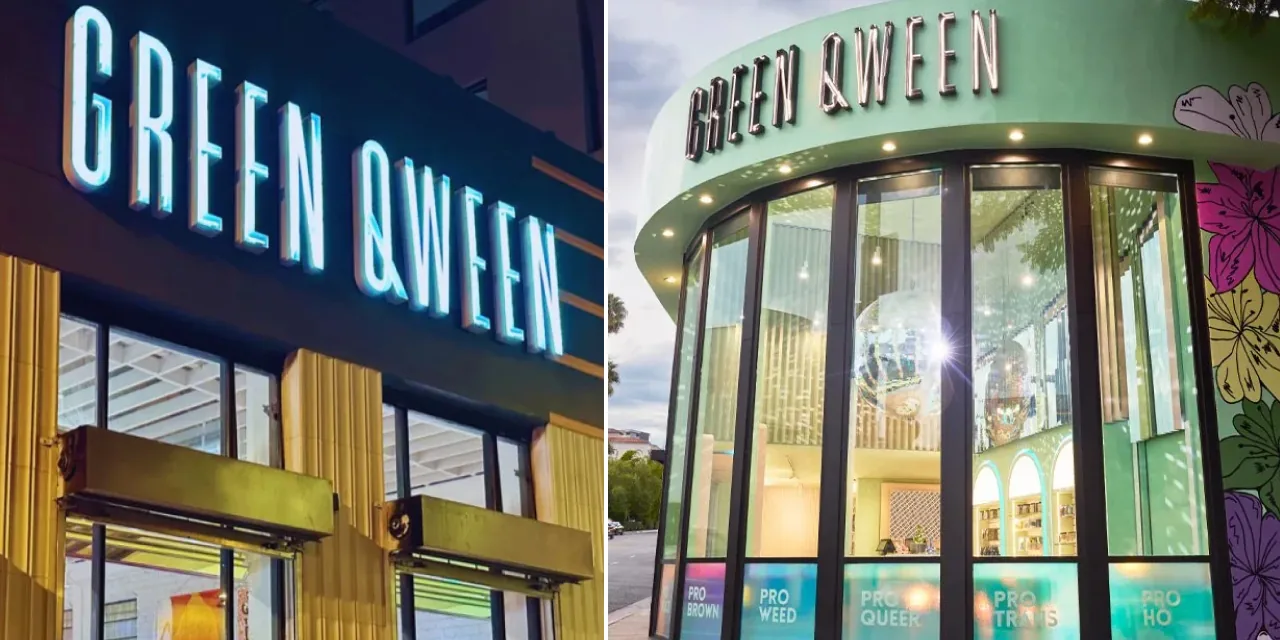
Downtown Los Angeles' first LGBTQ+ and BIPOC-owned social equity dispensary, co-founded by Andrés Rigal and Taylor Bazley. The Art Deco and Memphis-influenced interior by Visual Elements features a Studio 54 disco ball, arched display shelves, 25-foot vaulted ceilings, and a gender-neutral palette. It won a 2022 Clio Cannabis Bronze in Brand and Retail Design and a 2023 Clio for its "Turndown Service" collaboration with The Hoxton Hotel.
The brand now runs two stores, the DTLA flagship at 1051 S Broadway and West Hollywood at 802 San Vicente, WeHo's first queer-owned dispensary, with a Patrick Church mural and signage reading "Pass Joints, Not Judgment." A third location in Sherman Oaks has since closed. The WeHo launch drew organic amplification from RuPaul, Cara Delevingne, and Demi Lovato.
That last detail is the operative one. Celebrity reach arrived because the brand stood for something specific, not because it was purchased. Rigal's framing: "Queer all year isn't our catchphrase, it's our commitment." Worth noting for anyone benchmarking against these wins: the Clio Cannabis program has been on hiatus since 2024, so there is no active retail design award cycle right now.
JARS Cannabis - Turning a Format Into a Campaign
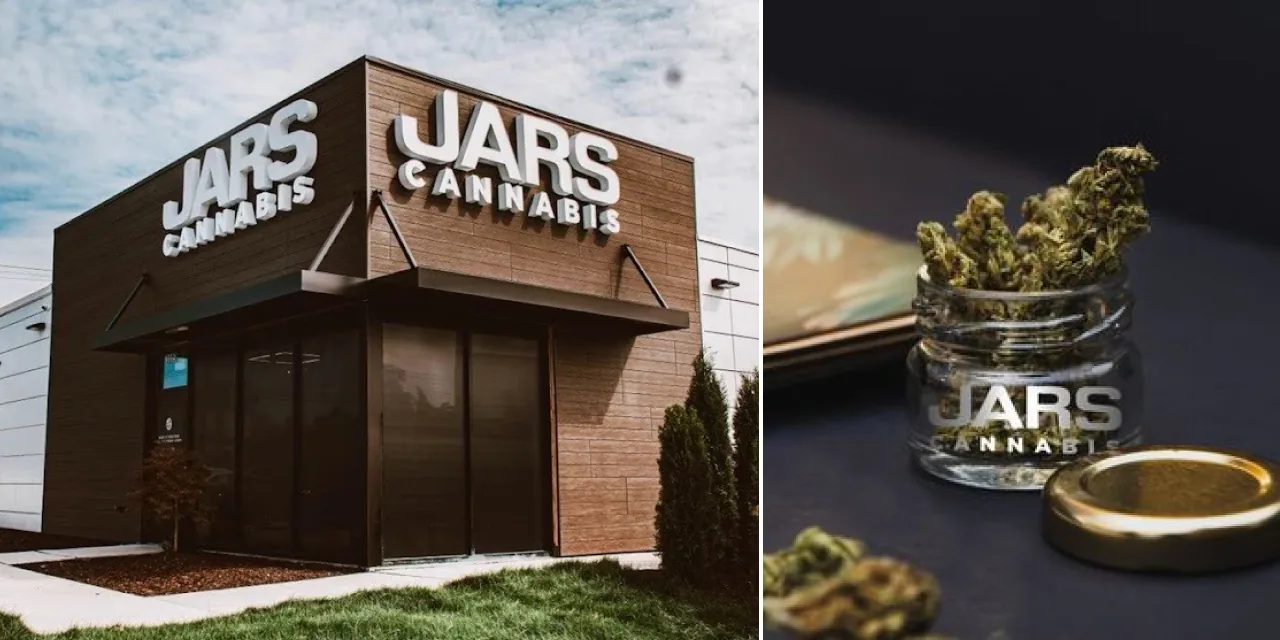
Deli-style flower, where customers see and select by weight from jars, is an operational choice. JARS made it a brand. Per the company, deli-style accounts for 40% of all flower sales, 12% of total revenue, and a 6% year-over-year sales increase.
Then it built a holiday around it. "The Deli Day" launched May 3, 2025 across Michigan locations with a free half-ounce for the first 100 customers per store, a free eighth for every customer, and BOGO pricing on deli-style flower. The Michigan context makes the move sharper than it looks: with 840+ dispensaries and retail pricing compressed to roughly $2.96 per gram, differentiation on price is not available. Differentiation on how the product is merchandised still is.
Read alongside Perfect Union's Oil Day, these are the two cleanest manufactured-holiday case studies in the industry, and both started from something the operator already did every day.
Planet 13 - The Cautionary Half of the Story
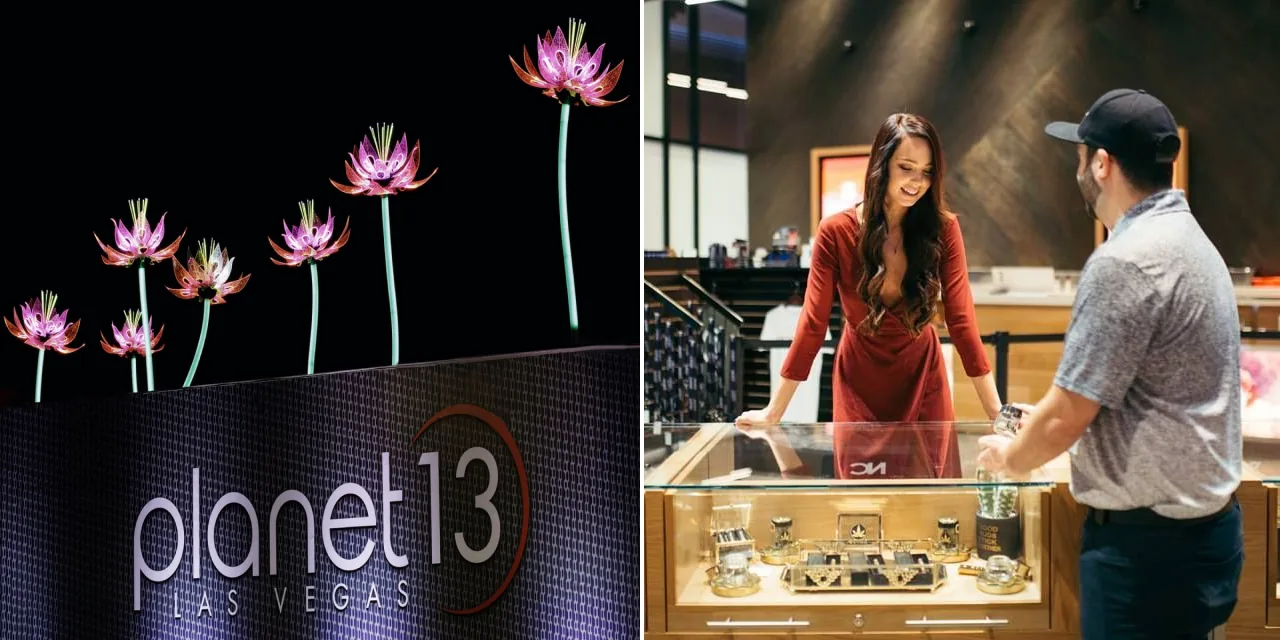
Planet 13's Las Vegas SuperStore defined experiential cannabis retail: an 18-foot LED water globe emitting fog and mist, 15-foot interactive lotus flowers, a vintage bus inside that emits "smoke" on demand. It pioneered dispensary-as-destination and, through the Dazed concept, consumption lounges. It belongs on this list for what it proved.
It also belongs here for what it disproved. In February 2026 the company announced substantial completion of its California exit, closing the 55,000-square-foot Santa Ana SuperStore and divesting its Orange County retail and distribution licenses, while expanding in Florida with a Pace dispensary near Pensacola.
Spectacle is expensive, and it does not travel. The Las Vegas store works because it sits in a market where tourists arrive already looking for an attraction. Rebuilt in Santa Ana, the same concept was a large fixed cost attached to a customer who wanted to be in and out in six minutes. Study Planet 13 for ideas. Do not treat it as a template.
The Pattern
Three themes connect these ten:
- Owned channels beat borrowed ones. Every operator here built something it controls outright - an app with 820,000 members, a holiday, a state fair concession, a 20-year lease with signage rights. That is the rational response to a category where the paid channels are restricted, and it is why loyalty and events keep outperforming advertising spend in cannabis retail.
- Format is a thesis, not a floor plan. Embarc optimizes for dwell time and discovery. Mint optimizes for throughput and access. Both work. What doesn't work is a store that hedges, and hedging is the most common condition in the category.
- The brand concept should reach the loyalty program. Press Pass Club with Columnist, Editor, and Publisher tiers. Canvas Club. Cabbage Club. Most operators invest heavily in a storefront concept and then name their tiers Bronze, Silver, Gold. Carrying the idea through to the retention mechanic costs nothing and is the cheapest differentiation available.
For operators planning 2027 store builds, loyalty rebuilds, or promotional calendars, this is the cohort to benchmark against.