We Tracked How a Cannabis Back Office Really Uses AI - Here's the Data
AI · By Headquarters · June 2, 2026
Most commentary on AI in cannabis is guesswork - vendor surveys, conference anecdotes, and predictions about what teams might eventually do. We are in a position to do something different. We can measure it.
Headquarters runs the back office for some of the largest cannabis enterprises in the world, and we track application and URL activity across our teams through Hubstaff, the productivity platform we use to see where working time actually goes. So we don't have to guess which AI tools our people reach for, how long they spend inside each one, or how quickly adoption spread. We have the activity data. Here is what it shows - and what it suggests for any operator trying to turn AI into real leverage.
From 9% to 88% in five months
In January 2026, 9% of the organization used AI tools in a measured period. By May 2026, that figure was 88% - a standing start to near-universal adoption in a single quarter and change.
!Share of Headquarters team using AI tools, January 2026 (9%) to May 2026 (88%)
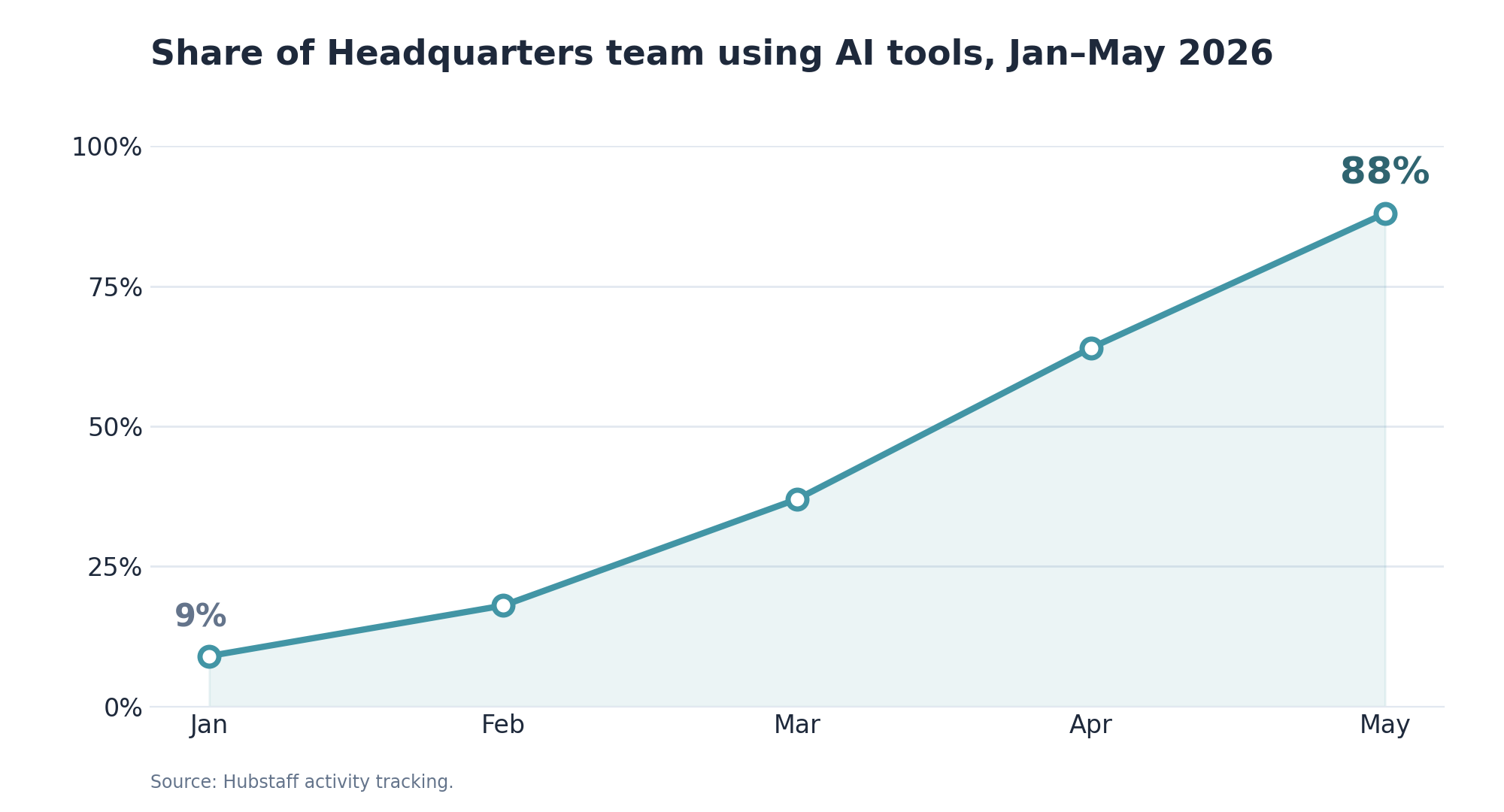
Adoption that fast is not a procurement story. Buying licenses takes an afternoon; getting an entire back office to change how it works takes something else - which is exactly where most organizations stall. McKinsey's 2025 survey shows most organizations now use AI somewhere in the business, yet far fewer capture real value - BCG places only about 5% in the "future-built" cohort that sees outsized returns, while the majority report minimal gains. The differentiator is never the model. It is whether the work gets redesigned around the tool. The climb from 9% to 88% happened because specific workflows got rebuilt around AI, not because people were handed logins.
Which tools the team actually reaches for
Adoption is not uniform across tools, and the split is the most instructive part of the data.
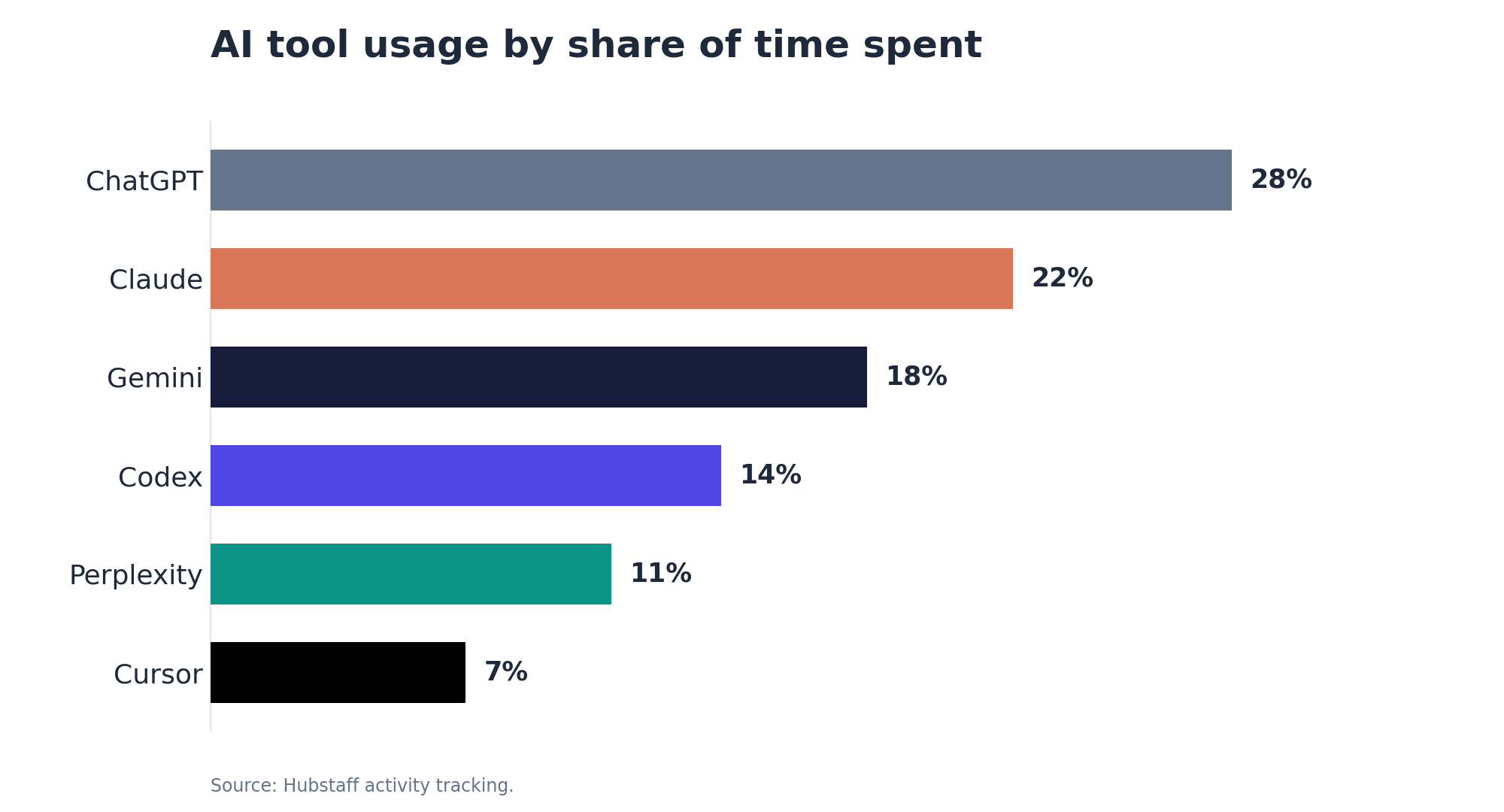
ChatGPT, Claude and Gemini are the three most-used platforms. They are the general assistants and research grounding for daily work: quick answers, summaries, the first stop for fact-finding. They are the backbone, and for most people they are the entry point into using AI at all.
The agentic tools - Claude Desktop, Codex, and Cursor - are seeing the sharpest recent growth, and they are where the heavier work happens. A chat assistant answers a question; an agent completes a task, navigating and extracting and drafting until it hands back a finished artifact.
Question that defines AI in cannabis
If the highest-value work is agentic, completed inside real systems, how do those agents reach the platforms where cannabis data lives? The answer is where cannabis diverges from the rest of the software economy, and most operators have not priced it in yet.
In mainstream commerce, the agent-native layer is arriving fast. Shopify now ships built-in MCP support on every store by default - a storefront server an AI agent can use to search the catalog, build a cart, and hand back a checkout link, with no custom setup. BigCommerce offers its own first-party Storefront MCP server for the same kind of agent-driven shopping. The pattern is consistent: the platform meets the agent halfway, and the integration is clean.
Cannabis platforms are earlier in that build cycle. Across dispensary POS, wholesale B2B marketplaces, and market-analytics providers, agent-native connectors are largely still on the roadmap rather than in production. This is not a knock on the vendors - cannabis software serves a smaller, more fragmented, heavily regulated market, and the open standard behind these connectors is itself less than two years old. The connectors will come. They are simply not here yet.
That leaves a gap between now and then. Operators who treat the gap as a reason to wait are leaving real, available gains on the table.
The bridge is browser-use. When a platform does not yet offer an agent connector, a browser-based agent can still operate the software the way a trained analyst does - logging in, applying the right filters, navigating to the correct report, and exporting the data. It is less elegant than a native connector and it requires thoughtful setup, but it works today, on the systems cannabis teams already pay for. Browser-use is how cannabis teams close the connector gap themselves, one workflow at a time, without waiting for a vendor release.
Skills are the new SOPs
The tool is only half the story. The durable asset is the skill.
A skill is a documented, repeatable procedure that an agent executes - the standard operating procedure, except it runs itself. Instead of a static SOP buried in a shared drive that a new hire reads once and forgets, a skill encodes the exact steps, context, and judgment of the team's best operator, and any team member can invoke it on demand. Tools change every quarter. The skill library compounds.
This is not a cannabis-specific insight; it is simply arriving in cannabis now. Bain & Company runs an internal "GPT Olympics" where employees have built more than 2,000 custom tools, with the best promoted into a firm-wide marketplace - one of them, "Answer Copilot," surfaces senior-partner expertise that used to live locked in individual inboxes. McKinsey built Lilli, a research assistant that synthesizes the firm's institutional knowledge for 40,000 consultants. The pattern is consistent across professional services: capture the repeatable expert work as a reusable asset, and the whole organization levels up.
The evidence that this lifts the floor, not just the ceiling, is strong. The landmark BCG/Harvard study of knowledge workers found that those using AI completed tasks 25% faster and produced work rated more than 40% higher in quality. The lowest-performing workers improved the most, gaining 43% against a 17% lift for top performers. Skills are how that effect scales: the best analyst's method becomes everyone's baseline.
What it looks like on the ground
The clearest way to understand the cannabis AI playbook is to watch it run inside the departments where it has taken hold. In our organization, by Hubstaff's intensity data, the top departments by usage are Marketing, Inside Sales, Engineering, Operations, and Recruiting. Marketing indexes highest on usage. But Inside Sales shows the playbook most vividly, because its core workflow is the connector gap made concrete.
Inside Sales: from data retrieval to insight
Market-analytics platforms - Hoodie Analytics, Headset, and LitAlerts among them - are where most competitive intelligence in cannabis starts. They aggregate menu and sell-through data across markets into the dashboards brands and retailers use to understand share, pricing, and velocity. They are genuinely valuable, and they are HQ partners.
The work of turning those dashboards into a partner-ready insight has historically been a retrieval grind. An analyst logs into each platform, applies a specific set of filters, exports raw CSVs, and only then begins the actual job - reconciling the data and shaping it into something a Head of Sales can act on. The retrieval consumes hours that should go to interpretation.
Browser-use collapses the retrieval step. Two skills now carry the load:
- A data-extraction skill drives the analytics platform through the browser - applying the right filters and pulling the raw reports automatically, across these platforms and others in the stack.
- A competitive-insights skill takes that raw data and applies cannabis-specific context - category dynamics, brand positioning, market-by-market nuance - to produce the actionable read a Head of Sales actually needs.
The analyst stops spending most of the cycle on retrieval and starts spending it on judgment. That is the connector gap closed by hand. It is also the pattern that travels best: find a report you rebuild constantly, automate the extraction with browser-use, and encode the interpretation as a skill.
Marketing: the highest-intensity team
The applied results outside cannabis set the benchmark. BCG's 2026 study of CPG marketing leaders found that teams adopting custom GenAI workflows spent 25% to 40% less time on key marketing tasks and brought work to market roughly twice as fast, with documented marketing-ROI gains of up to 50%. Inside cannabis, the agency NisonCo reported a 48% increase in weekly leads - from 270 to nearly 400 - while reducing its research headcount, alongside roughly $30,000 in annual savings from automating research, outreach, and follow-up.
This is the work behind the marketing team's outsized use of Codex and Cursor: generating email-template variations and surfacing loyalty insights at a volume manual builders cannot match. Around it sit skills for first-draft SEO content and product descriptions, and - distinctive to this industry - skills tuned to write compliant copy for a restricted category, where a careless health claim is a regulatory problem, not just a brand one. The human still owns voice, judgment, and final approval. The agent owns the draft and the grunt work.
Recruiting: where AI ramps the new hire
Recruiting sits lower on the intensity chart, but it is where we have been most deliberate, because the stakes of a bad call are high and the work is repetitive enough to automate well. Three workflows are live:
- Resume screening. Rather than a recruiter eyeballing hundreds of resumes against a job description, a skill parses each one against the role's real requirements and returns a ranked shortlist with the reasoning attached, so a human can check why a candidate scored where they did. The recruiter reviews a shortlist instead of a pile.
- Interview scoring for grounding. Every interview is scored against the same structured rubric, so the evaluation stays consistent from candidate to candidate and interviewer to interviewer. The score is grounding, not a verdict. It gives the hiring team a shared, evidence-based reference point and flags where a gut read diverges from the rubric, which is usually where unexamined bias hides. A consistently applied structured rubric is one of the better-documented ways to keep individual interviewer bias out of the decision.
- Sourcing and outreach. Candidate research, background checks, screening-call summaries, and outreach sequencing - the high-volume work that used to eat a recruiter's week.
The BCG finding applies cleanly here: AI lifts the lowest performers most. A new recruiter equipped with the team's best screening and research skills works closer to a veteran's baseline from week one. The skill library is institutional onboarding that runs itself, and because the scoring is structured and the reasoning is always attached, the output stays reviewable rather than a black box.
Engineering, Design, and Operations: the engine room
The agentic-coding tools live here. Cursor and Codex handle development work - and the University of Chicago found that engineering teams defaulting to an AI coding agent merged 39% more pull requests with no rise in revert rates. Just as important, this is where the browser-use agents and skills that the other departments rely on actually get built and maintained. Operations runs the same agentic tools across client meeting transcripts - turning raw calls into extracted action items, sentiment scores, and customer-success follow-through - and leans on Claude for analytics and internal tooling. The engine room is what turns a clever one-off prompt into a skill the whole company can run reliably.
Where to start
The connector gap is temporary. Cannabis platforms will ship agent-native connectors, and when they do, the integrations will get cleaner and faster. But the teams that build the browser-use and skills muscle now are the ones positioned to exploit those connectors the moment they land - and in the meantime, they are capturing the gains while everyone else waits.
For an operator deciding where to begin, the path is concrete:
- Inventory the stack. List the platforms your teams touch daily and note which expose an agent-native connector and which do not. The "not yet" list is your browser-use opportunity map.
- Pick one high-frequency, measurable workflow. The report you rebuild every week is the obvious first target - the Inside Sales extraction pattern generalizes to almost any recurring data pull.
- Build it as a skill, not a one-off. Encode the steps and the context so the work is repeatable by anyone, and so it survives the analyst who built it.
- Measure against a baseline. Capture today's hours-per-report and adoption rate before you start. The organizations that document the before-and-after are the ones that get from 9% to 88% on purpose.
The research keeps landing on one point: the value of AI does not come from the model. It comes from redesigning the work around it. In cannabis, where the connectors have not arrived yet, that redesign starts with a browser, a skill, and a decision not to wait for the vendors.